Chiropractor Marketing: Demand Grew 49% and Your New Patient Count Didn’t
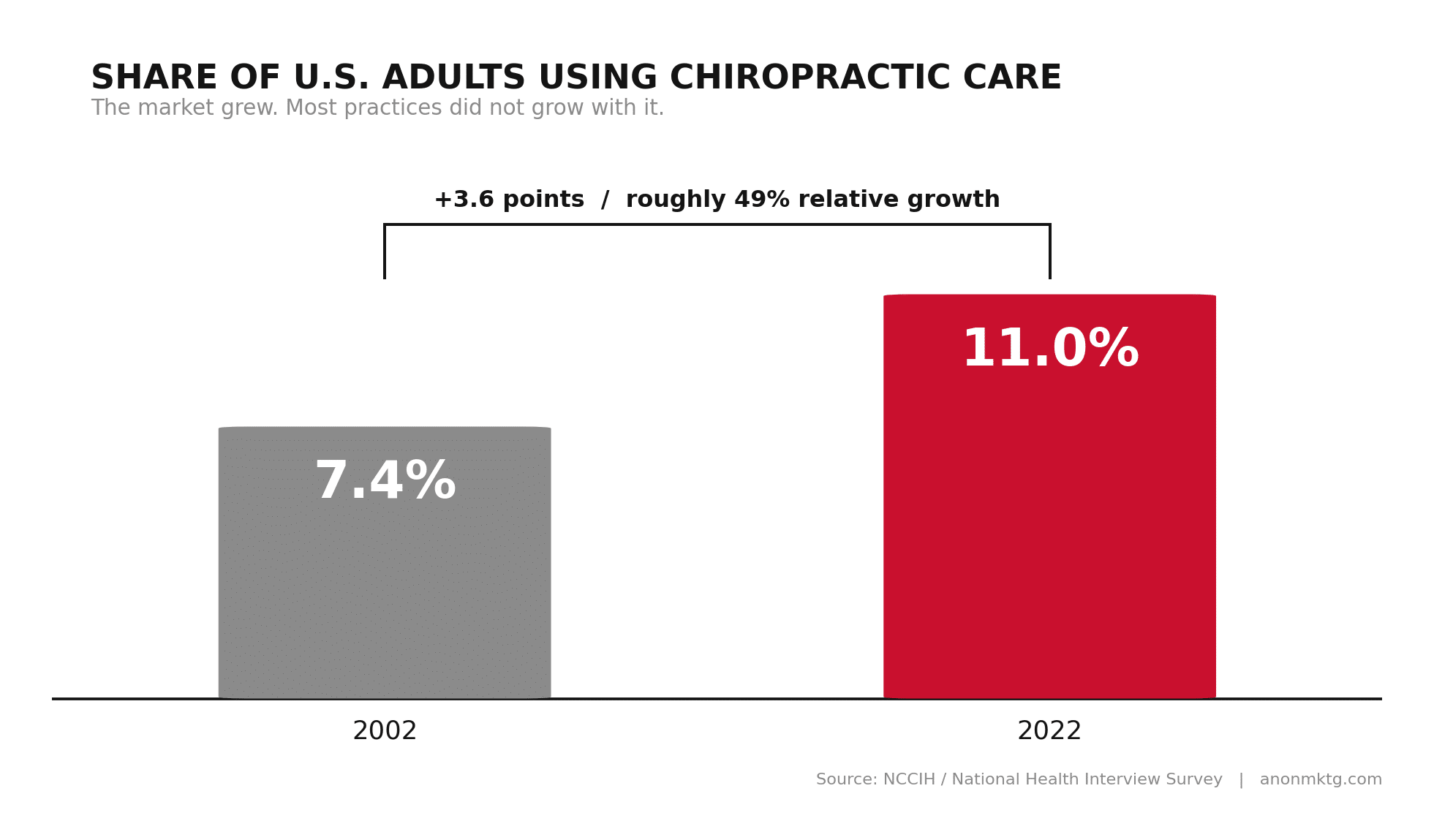
The market is moving in your favor. According to the National Center for Complementary and Integrative Health, 11.0 percent of U.S. adults used chiropractic care in 2022, up from 7.4 percent in 2002. NCCIH also reports that 85.7 percent of those patients came for pain management.
Chiropractic utilization among U.S. adults grew by roughly 49 percent between 2002 and 2022. Source: NCCIH / National Health Interview Survey.
More people want what you do, and the overwhelming majority of them arrive with a specific, urgent, searchable problem.
So when a practice tells us new patient counts have been flat for two years, the market is not the explanation. Something between the search and the front desk is broken. Here is where we usually find it.
1. You are measuring clicks in a business that runs on care plans
Chiropractic economics are not built on the first visit. They are built on the treatment plan that follows it, and on whether the patient completes it.
That means the interesting number is never website traffic, and it is rarely even new patient leads. It is new patient appointments actually attended, converted to care plans, with a completion rate attached. A practice generating forty inquiries a month at a twenty percent show rate is in far worse shape than one generating twenty at a seventy percent show rate, and no traffic report will ever tell you that.
Most of the leakage lives in places marketing reports never look. Calls that ring out during the lunch hour when the front desk is covering treatment. Forms submitted Friday evening and answered Monday afternoon, by which time the patient has booked somewhere else. New patient specials that pull in people who wanted the special and never intended to start care.
You cannot solve a front desk problem by buying more ads. Find the leak first.
2. The tracking pixel on your website is a compliance question
This is the section most chiropractic practices have never had explained to them, and it is the one carrying real risk.
If your site runs a Meta Pixel or Google Analytics on pages where patients book appointments, complete intake forms, or access a portal, you may be transmitting patient information to a third-party advertising platform. HHS Office for Civil Rights addressed this directly in its guidance on online tracking technologies.
The legal picture shifted in June 2024, when a federal court vacated the portion of that guidance treating a visitor’s IP address combined with a visit to an unauthenticated public webpage about a health condition as protected health information. That was a meaningful narrowing, and it took the most aggressive interpretation off the table.
What it did not do is hand anyone a clear runway. The rest of the guidance stands. Tracking technologies on authenticated pages, patient portals, and booking flows still touch PHI, which still requires a business associate agreement with the vendor or valid patient authorization. OCR has also stated it is prioritizing HIPAA Security Rule compliance in its investigations into tracking technology use.
The practical version for a practice: know which pages collect patient information, know what scripts fire on those pages, and do not let a marketing vendor drop conversion tracking into your booking flow without anyone reviewing what it sends. Getting this wrong is expensive in a way a bad ad campaign never is.
3. Local Services Ads give healthcare no safety net
Plenty of practices run Google Local Services Ads, and they can work well. But there is a line in the fine print that changes the risk math considerably.
Google’s documentation on automated Local Services Ads lead credits states plainly that lead credits are not available for health care verticals. In other trades, a lead that arrives wildly off target may get credited back automatically. In healthcare, it does not. You pay for it.
That makes upfront configuration the whole ballgame. Service areas need to reflect where patients will realistically drive for ongoing care, not aspirational geography, because a care plan requires the patient to return repeatedly. Job types need to match what you actually treat. Your hours need to be accurate, because you will be charged for calls that come in during hours you said you were open.
It also raises the value of answering the phone. Every LSA lead is paid for whether or not anyone picks up, which makes a missed call in this channel a direct, quantifiable loss rather than a vague missed opportunity.
4. Google treats your site as a health site whether you like it or not
Health content sits in the category Google’s quality raters scrutinize most heavily, and chiropractic content sits in a corner of it where claims are actively contested. That has consequences for how your pages get evaluated.
Google’s guidance on creating helpful, reliable, people-first content asks whether content demonstrates first-hand expertise, whether it comes from someone with clear credentials on the topic, and whether a reader would trust it enough to act on it.
For a practice site, that translates to specifics. Real bylines from your actual doctors, with credentials and licensure. Bios establishing where they trained and what they treat. Content describing the conditions you handle and what a course of care actually looks like, rather than recycled copy about subluxations that appears on four hundred other chiropractic websites.
It also means being careful with claims. Content overstating what chiropractic care treats invites both a search quality problem and a state board problem. The most credible page is usually the one explaining the realistic range of outcomes for a specific complaint, because that is also the page that converts the patient who has already read three other sites and is deciding who to trust.
5. Patient testimonials are a legal minefield now
Testimonials sell chiropractic care better than almost anything else, which is why practices lean on them. Two things have changed.
First, the FTC’s Rule on the Use of Consumer Reviews and Testimonials took effect in October 2024 and carries civil penalties for knowing violations. It prohibits fake reviews, requires disclosure when a review comes from a company insider, and bars review suppression, meaning the widespread practice of routing satisfied patients to Google and dissatisfied ones to a private form is no longer defensible.
Second, several state chiropractic boards impose their own restrictions on testimonials and outcome claims in advertising, and those rules vary enough that you cannot assume what a colleague does in another state is permissible in yours.
None of this means stop collecting reviews. Ask every patient. Respond to critical ones publicly and professionally without disclosing any patient detail, which is its own HIPAA trap. Get written authorization before publishing anything identifiable. Then check your state board’s advertising rules, because that is the one nobody remembers.
The pattern underneath all five
Chiropractic marketing fails less often from bad ads than from a disconnect between the marketing and the operation. Traffic arrives, calls go unanswered, tracking is misconfigured, content sounds like every competitor, and nobody measures the one number that matters: whether new patients start and complete care.
Fixing that requires an agency willing to look past the campaign at the practice. Our marketing for health care providers tracks campaigns to attended appointments and care plan starts, tells you when the problem is your front desk instead of your ad spend, and builds sites that do not create compliance exposure on the way to a conversion.
If your marketing cannot tell you how many new patients started care last month, contact Anonymous Marketing and let’s talk about what your reporting should actually show you. You can also see the full scope of what we do for health care providers.
This article is general marketing guidance, not legal or compliance advice. Consult qualified healthcare counsel regarding HIPAA obligations, FTC compliance, and your state chiropractic board’s advertising regulations.