Pest Control Marketing: You’re Running a Subscription Business and Marketing It Like a Handyman Service
Pest control has one of the best business models in home services. One acquisition can turn into quarterly service for a decade. Compare that to a roofer, who spends real money to win a customer and then does not hear from them again for twenty years.
So why does almost all pest control marketing get measured like a one-time transaction?
Ask most operators what their marketing produced last month and you will get a lead count. Maybe a cost per lead. Occasionally a call recording somebody listened to back in March. What you almost never get is the number that actually matters: how many of those leads became recurring plan starts, and what those plans are worth over their lifetime.
That gap is where pest control marketing budgets quietly go to die. Below are the six things we look at first when we take over a pest control account.
1. Stop counting leads. Start counting plan starts.
A one-time bed bug treatment and a signed quarterly plan are not the same event, and treating them as equal in your reporting will steer your entire budget in the wrong direction.
Here is what happens when you optimize on raw lead volume. Emergency and one-time searches are cheaper and convert faster, so the algorithm feeds you more of them. Your lead count goes up. Your cost per lead goes down. Your agency sends a report with a lot of green arrows on it. Meanwhile your recurring revenue base is flat, because none of that volume turned into a plan.
Fix the measurement and the strategy fixes itself. Your funnel should track lead, qualified call, booked job, completed job, plan start, and plan retention. Plan starts should carry a higher assigned value than one-time jobs, because they are worth more. Once that value flows back into your ad platforms as a conversion signal, the bidding starts chasing the right customer instead of the cheapest one.
Keyword rankings do not renew. Plans do.
2. Your pest calendar is your media plan
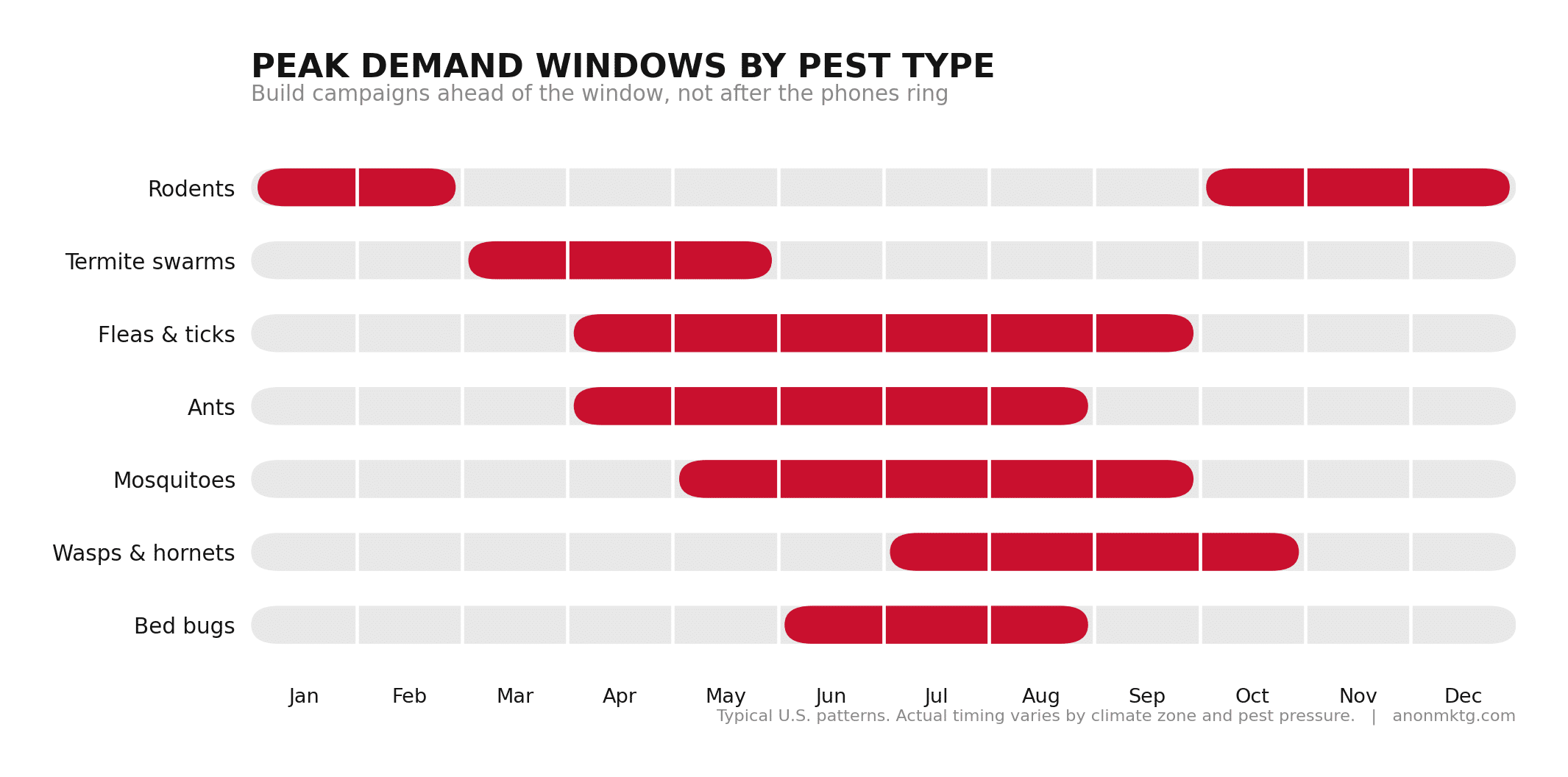
Termite swarms, mosquito season, fall rodent migration, and bed bug complaints all peak at different times. Every operator knows this. Almost nobody budgets around it.
Peak demand windows by pest type. Typical U.S. patterns, which vary by climate zone and local pest pressure.
The common pattern is reactive. Demand spikes, the phones light up, and only then does anyone think about increasing spend or building a landing page. By the time the campaign is live, the window is half over and cost per lead has already climbed, because every competitor in the market woke up at the same moment.
Build the opposite way. Landing pages, ad copy, budget increases, and call coverage should be ready before each window opens, not after. Content for termite season should already be indexed and ranking months ahead of the swarm, because organic pages need runway. Paid budget should shift by pest category on a schedule you set in advance.
The staffing side matters just as much. There is no point buying peak season demand if calls roll to voicemail at 6:15 PM on a Thursday in June.
3. Local Services Ads no longer have a refund button for sloppy setup
This one costs pest control companies real money and most of them have not noticed.
Google used to let advertisers dispute leads that came in outside their service area or for a job type they do not perform. That is gone. Under the current automated system, Google no longer supports credits for “job type not serviced” or “geo not serviced” leads. Credits are now issued by machine learning models that reassess charged leads over time, and when one is approved it generally lands on your account balance within 30 days while the original charge still appears on your invoice.
Translation: your LSA profile configuration is now a budget line item. Every job type you leave switched on that you do not actually want is an open door to a lead you will pay for with no recourse. Every ZIP code in your service area that you cannot profitably reach is the same thing.
Go through your job types and turn off everything you do not want to be called about. Trim your service area to the geography you actually service well. Then rate your leads, because the feedback survey is what trains the system on which leads suit your business, and it is one of the few levers you have left.
4. The Google Business Profile setting that gets pest control companies suspended
Most pest control operations are service-area businesses. You go to the customer. Customers do not come to you.
Google’s guidelines for representing your business are direct about what that means. If you run a service-area business, you are supposed to hide your business address, and if you operate out of a residential address, you clear it from the profile entirely. Google also sets an expectation on reach: your service area should generally not extend beyond roughly two hours of driving time from where the business is based.
Ignoring either one is a common route to suspension, and a suspended profile in a business this dependent on the local pack is a genuine revenue emergency. If you have branch locations with their own service areas and their own staff, you are entitled to a separate profile for each. If you have a mailbox at a UPS Store in the next county over, you are not.
5. Your review request process may now be illegal
Home services has been doing this for years: text every customer after a service, route the happy ones to Google, route the unhappy ones to a private feedback form. It works. It is also now prohibited.
The FTC’s Rule on the Use of Consumer Reviews and Testimonials took effect on October 21, 2024, and authorizes courts to impose civil penalties for knowing violations. Those penalties currently run north of $50,000 per violation. The rule covers fake reviews, undisclosed insider reviews, and review suppression, which is exactly where the sorting practice lands. Selectively surfacing positive reviews while steering negative ones somewhere private is treated as deceptive, because it misrepresents overall customer sentiment.
This stopped being theoretical in December 2025, when the FTC sent its first round of warning letters under the rule, directing recipients to halt non-compliant practices and confirm their corrections in writing.
The compliant version still works. Ask every customer, not a filtered subset. Make it easy. Respond to the bad ones publicly and fix the underlying service problem. A 4.7 with 300 reviews and thoughtful owner responses outperforms a suspiciously perfect 5.0 anyway, both with customers and with Google.
6. The EPA already wrote your content outline
Pest control content usually reads like it was written to hit a keyword. Here is a better source.
The EPA publishes a consumer guide called Choosing a Pest Control Company, and it exists to tell homeowners exactly what to ask before hiring anyone. Licensing. Applicator certification. What the treatment plan involves. Safety around kids and pets. Whether the company will actually explain the pests it found.
That is a list of the questions your prospects are being coached to ask. Every one of them is a page on your site, an FAQ block, or a section of a service page. Answer them better than your competitors and you win the search result and the sales conversation at the same time. It beats another thin 500-word post about ants.
Where most of this actually breaks
None of the above is secret. The reason it does not get done is that the owner of a growing pest control company is busy running routes, hiring techs, and keeping trucks on the road, while the agency they hired is optimizing for metrics that are easy to report on rather than the ones that build enterprise value.
We work the other way around. Our home services marketing ties campaigns to plan starts, builds paid budget around your pest calendar instead of the fiscal quarter, and reports what every call was worth instead of how many keywords moved up two spots.
If your current marketing cannot tell you how many recurring plans it produced last quarter, contact Anonymous Marketing and we will show you what that reporting should look like. You can also see the full scope of what we do for home service businesses.
This article is general marketing guidance, not legal advice. Consult your own counsel regarding FTC compliance and pesticide advertising regulations in your state.